Solar
Unlock a Brighter Future: JOEMC Guides You Through the Booming Solar Energy Landscape and Declining Solar Panel Costs
Solar energy is booming, and the future is brighter than ever. At this time, solar panel prices are on the decline, and technology is improving at a rapid pace. However, JOEMC encourages members to know all the facts about how homeowners can harness the sun’s natural rays through rooftop solar panels to produce environmentally friendly and cost-effective electricity. JOEMC is proud to be your solar advisor.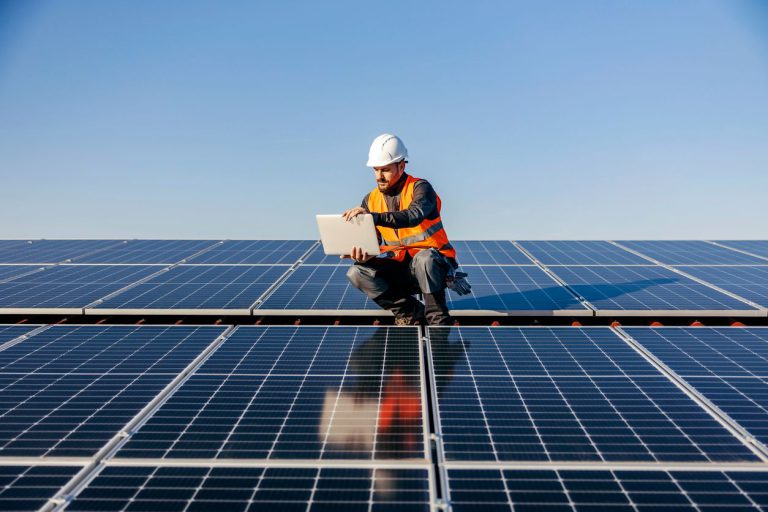
How Does Home Solar Really Work?
Whether you are interested in mounting solar panels to your roof or would like to add ground-mounted solar to your property, the sunlight-to-electricity conversion process works the same:
- During daylight hours on low-cloud days, sunlight will shine on your panels. These panels are often called photovoltaic or PV panels because they support the photovoltaic process of absorbing and converting light to electricity.
- The newly created electricity must be converted from direct current (DC) to alternating current (AC), which is the kind of current used in the United States because it can be “stepped up” to support traveling long distances and “stepped down” to an appropriate voltage for household appliances. The conversion to alternating current occurs in a device called an inverter.
- In most cases, the newly formed alternating current runs through your home’s electrical panel and powers some of your home energy needs. If your home needs more energy than the solar panels can provide, you will draw metered power from the grid, just as you would have before installing panels.
How Do Members Start the Process
If you are considering installing solar panels on the roof of your home then the size is likely to range from 1kW to 25kW and our local office can give you the paperwork to assist you through the process (Standard for Interconnecting Distributed Resources 25 kW or less with Jones-Onslow Electric Membership, Interconnection Service Agreement and Application for Interconnection and Application to Interconnect Distributed Resources.)
Most customers work with their solar vendor to assist with the paperwork and the coordination of panel installation, electrical wiring, and setting up the inspection of the work with the appropriate county inspections office. There is a one-time application fee of $100 for residential or $250 for commercial that must be paid to JOEMC with the completed application.
If you are considering turning large acres of land into a solar farm and the size of the project will be greater than 25kW, JOEMC can provide you the paperwork to get the process started (you’ll need to call the office at (910) 353-1940 or (800) 682-1515). A $1,000 deposit for initiating a facilities impact study agreement is required as an engineering study must be performed for this size of project. With a facility of this size (or greater), the purchase power agreements would be through JOEMC’s power supplier, North Carolina Electric Membership Corporation (NCEMC) located in Raleigh, NC. The interconnection agreement and interconnection facilities would be with JOEMC.
Regardless of the solar facility size, any modifications or construction cost to the JOEMC’s distribution will be paid by the owner and required prior to interconnection. The interconnection standards and agreements also include other requirements of owning a grid-tied solar installation.20
Frequently Asked Questions
Whether you’re just getting started or have thoroughly researched solar energy, give our Energy Specialists a call (910-353-1940) for a free home energy assessment and to review your energy-savings goals before committing to a solar contract.
Unfortunately, we’ve seen instances in our community where members have been misled and misinformed because of inaccurate information. We’re here to be your energy partner throughout the process, helping you to arrive at a decision right for your home and personal goals.
Another thing we always recommend is to improve the energy efficiency of your home. A more efficient home stretches your energy dollar further, and you’ll recover the expense of your solar investment more quickly.
Depending upon the size and efficiency of your system and home, most homeowners see savings on their electric bill. Some solar companies make claims that you’ll never have to pay an electric bill again, and we caution this is simply not true. Your home requires electricity even if the sun is shining, including at night and on cloudy days, which means you will continue to draw electricity from the grid and be billed monthly based on your home energy use and any basic facilities charges.
JOEMC members with home solar are still connected to the grid. Because we are an at-cost, not-for-profit cooperative energy provider, standard charges that all members pay to ensure the reliability and safety of the electric grid for all will stay on your bill, no matter how much energy your home may produce. Without this structure, grid costs would unintentionally be shifted to members for whom home solar is out of reach for financial, geographic or other reasons.
This is a common question and a concept often clouded by misinformation. The best thing you can do is contact us, and one of our Energy Specialists will help you determine if solar is the right fit for meeting your financial goals.
Each of North Carolina’s 26 electric cooperatives is independent and governed locally by an elected board of directors, which is responsible for setting and reviewing policies. This means our policies may differ from our neighboring co-ops because of our local circumstances and needs.
At JOEMC, we compensate our members for their contributions at what is called “avoided cost” – or a price in line with what we pay for wholesale power before infrastructure and operational costs. Compensating our members for excess solar energy at “avoided cost” ensures they earn a fair price for what they produce while also paying for the infrastructure still utilized by the home.
Bottom line – Because policies vary, we encourage you to please contact us to make sure you have all the facts before purchasing solar installation. Solar installation companies may not be familiar with our co-op’s policies, and we don’t want anyone to enter into an agreement with misinformation.
Yes! The U.S. Department of Energy has a great tool for providing cost estimates on home solar installations. Please keep in mind this is an estimate only; you will have a more accurate financial picture by working with us and a professional solar installation company.
Ground-mounted and rooftop solar are both home solar solutions, and their difference are highlighted below for your consideration.
Ground-Mounted | ||||
Can place the array in an optimal location. | ||||
Easy to clean panels and make any needed repairs.
|
Yes! We support all energy solutions that are a fit for our members, uphold the safety and reliability of our grid and improve the diversity of our resources while also ensuring that costs are not shifted to members without home solar panels. Our nation’s electric grid is shifting from a model where large, centrally located generating plants produce power and push it to the far corners of the grid to a model that incorporates more distributed energy resources and technologies, like home solar. This is an exciting time in our industry, and we want our members to make a choice that is right for them. If your choice leads you to solar installation, we ask that you please let us know and work with us so you can make informed decisions and incorporate your new installation into our plans for managing electric traffic across our grid.
Yes, there is a federal solar tax credit that allows you to deduct 26 percent of the cost of installing solar from your federal taxes. There is no cap on its value, and the average savings is approximately, $9,000 according to the U.S. Department of Energy. Please note, these incentives decrease in 2023 and 2024. Consult with an accountant to determine your full rebate potential.